
Demystifying the @Transactional Annotation in Spring Boot

.jpg)
Introduction to the @Transactional Annotation
When working within the Spring framework, developers often encounter scenarios where transactional integrity is crucial for their applications. This is where the @Transactional annotation comes into play, serving as a powerful tool for managing transactions effortlessly.
Purpose of @Transactional Annotation
The primary purpose of the @Transactional annotation is to define the transactional boundaries for a method or a class. By annotating a method with @Transactional, developers ensure that the operations within that method are executed as part of a single transaction. If any part of the transaction fails, the entire operation can be rolled back, maintaining data consistency and integrity. For instance, consider a scenario where you are processing an online order. If your application deducts the payment but fails to update the inventory, it can lead to discrepancies. Utilizing @Transactional ensures that both operations succeed or fail together.
Benefits of Using @Transactional Annotation
Using the @Transactional annotation in your Spring Boot application comes with several benefits:
- Atomicity: It guarantees that a series of operations either fully complete or do not happen at all, which is crucial for maintaining data integrity.
- Declarative Transaction Management: With
@Transactional, developers can define transaction boundaries declaratively, simplifying code while improving readability and maintainability. - Less Error-Prone: By handling transactions automatically, developers reduce the risk of human error that can occur when managing transactions programmatically.
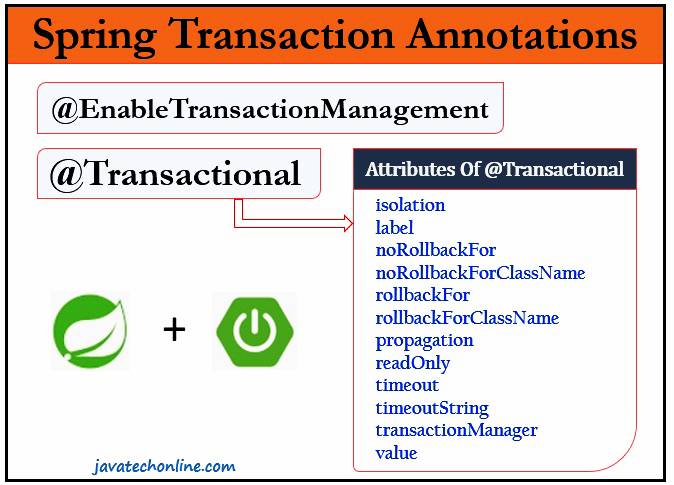
- Flexibility and Configurability: It allows various configuration options such as isolation levels, propagation behaviors, and rollback rules, which can be tailored to specific requirements.
- Improved Performance:
@Transactionalcan enhance performance by minimizing the number of database calls when multiple operations are grouped within a single transaction.
In summary, the @Transactional annotation serves as a fundamental component in Spring Boot for managing transactions effectively. It not only streamlines the development process but also ensures that applications can handle data operations with confidence, providing a robust foundation for building reliable software.
Understanding Transaction Management in Spring Boot
Continuing from our exploration of the @Transactional annotation, it’s essential to understand how transactions are managed in Spring Boot and the various propagation types available. This knowledge enables developers to use transaction management more effectively and tailor it to their application's specific needs.
How Transactions are Managed in Spring Boot
Spring Boot utilizes a robust transaction management system built on top of the Spring framework. Here’s an overview of how transactions are managed:
- Underlying Technologies: Spring handles transactions through its integration with various data access technologies, such as JPA, JDBC, and Hibernate. It provides an abstraction layer that keeps the transaction logic separate from the business logic.
- Transaction Manager: Spring provides different transaction manager implementations (like
JpaTransactionManagerfor JPA,DataSourceTransactionManagerfor JDBC) that facilitate the management of transactions in a Spring Boot application. - Automatic Handling: When a method annotated with
@Transactionalis called, Spring automatically opens a transaction before the method execution and commits it if the method completes successfully. In case of an exception, the transaction is rolled back, ensuring data integrity.
This means that developers can enjoy automatic transaction handling without having to write boilerplate code for managing them manually, fostering a cleaner codebase.
Different Propagation Types in @Transactional Annotation
Understanding transaction propagation types is crucial as it determines how transactions behave in different scenarios. Here are the main propagation types you can use with the @Transactional annotation:
- REQUIRED: This is the default setting. If a transaction exists, the method will join it; if not, it will create a new one.
- REQUIRES_NEW: This type always creates a new transaction. Even if there is an existing transaction, this method will run in a separate transaction context.
- NESTED: It allows a method to run in a nested transaction. If the outer transaction fails, the inner transaction can still roll back or commit separately.
- SUPPORTS: If a transaction exists, it will run within it; if not, it will execute without a transaction.
- MANDATORY: The method must run within an existing transaction; otherwise, an exception will be thrown.
- NEVER: This approach ensures that the method does not run within a transaction, throwing an exception if one exists.
- NOT_SUPPORTED: If there is a transaction, it suspends it and runs the method non-transactionally.
By understanding these propagation types, developers can better control transaction behavior and hierarchy, making it easier to build robust applications in Spring Boot that require careful management of transactional operations.
Working with @Transactional Annotation in Spring Boot
As we delve deeper into the practical use of the @Transactional annotation in Spring Boot, it's vital to grasp both the syntax for implementation and the nuances of nested transactions, including rollback rules. Mastering these aspects can help optimize the transactional behavior of your applications.
Syntax and Configuration Options of @Transactional
The @Transactional annotation can be used in various ways, allowing developers to configure it to their needs. Here’s a basic example of how to use it:
import org.springframework.stereotype.Service;

import org.springframework.transaction.annotation.Transactional;

@Service

public class OrderService {

    @Transactional

    public void placeOrder(Order order) {

        // Save order information

        orderRepository.save(order);

        // Deduct payment

        paymentService.processPayment(order.getPaymentDetails());

        // Update inventory

        inventoryService.updateStock(order.getProductId());

    }

}
In this example, all the operations within the placeOrder method will be managed as a single transaction. If any of them fail, the entire transaction will roll back, which is a significant advantage. Configuration Options:
- Propagation: Configure how the method should behave concerning existing transactions (as discussed earlier).
- Isolation: Set the isolation level for the transaction to define how data read and written by the method is isolated from other transactions.
- Timeout: Specify how long the transaction should wait before timing out.
- ReadOnly: Mark the transaction as read-only if it does not modify the database.
For instance:
@Transactional(propagation = Propagation.REQUIRES_NEW, isolation = Isolation.SERIALIZABLE, timeout = 30, readOnly = false)This allows fine-tuned control over how the transaction operates.
Nested Transactions and Rollback Rules
Nested transactions are a fascinating aspect of transaction management, allowing a transaction to be split into smaller parts. When using the @Transactional annotation, you can manage nested transactions seamlessly. To illustrate, consider the following scenario: Suppose you have a method that processes multiple tasks within a broader operation. If one of these tasks fails, you can roll back only that specific part, leaving other parts intact.
- Key Points:
- Rollback Rules: By default, only unchecked exceptions cause a rollback. You can customize this using the
rollbackForattribute of the annotation to specify which exceptions should trigger a rollback.
@Transactional(rollbackFor = { CustomException.class, SQLException.class })- No Rollback on Check Exceptions: Conversely, if you want to suppress rollbacks for checked exceptions, you can use the
noRollbackForattribute.
- Rollback Rules: By default, only unchecked exceptions cause a rollback. You can customize this using the
In practice, using nested transactions and rollback rules effectively ensures that your application behaves predictably under various failure conditions, preserving data integrity and enhancing user experience. Understanding these features of the @Transactional annotation empowers developers to create reliable and maintainable applications in Spring Boot.
Best Practices for Using @Transactional Annotation
Harnessing the full potential of the @Transactional annotation in Spring Boot comes with certain best practices that can enhance the performance and reliability of your applications. By focusing on optimizing transactional management and effectively handling exceptions, developers can create a seamless experience for users.
Optimizing Transactional Management in Spring Boot
To ensure transactions are managed efficiently, consider the following best practices:
- Scope the Transaction: Keep your transactional methods as short and focused as possible. This minimizes the time locks are held on database rows and improves overall system performance. For instance, if you have a complex method that encompasses many database operations, consider breaking it down into smaller, more manageable methods.
- Use the Right Propagation: Carefully choose the appropriate propagation type according to your business logic. For instance, if you want to ensure that a new transaction starts independently of any caller, use
Propagation.REQUIRES_NEW. This approach can effectively isolate critical operations, avoiding unexpected data anomalies. - Set Isolation Levels Wisely: Understand and choose isolation levels that suit your application’s consistency requirements without sacrificing performance. For example, if you’re heavily reading data without frequent updates, a lower isolation level like
READ_COMMITTEDmay suffice. - Read-Only Transactions: For operations that do not alter the database (like fetching data), use the
readOnlyattribute. This optimization can help your database recognize that the transaction will not modify data, potentially improving performance.
Handling Exceptions and Rollbacks Effectively
Exception handling within transactional contexts is crucial for maintaining data integrity. Here are some strategies for managing exceptions and rollbacks:
- Define Rollback Rules: Utilize the
rollbackForandnoRollbackForattributes to precisely control which exceptions should trigger a rollback. For example, if a specific business exception occurs, you may want to handle it without rolling back:@Transactional(rollbackFor = { Exception.class }) public void processOrder(Order order) { // logic here } - Centralized Exception Handling: Consider implementing a global exception handling mechanism using Spring's
@ControllerAdvice. This way, you can manage exceptions arising from transactional methods in a centralized manner, improving code cleanliness and maintainability. - Log Errors Appropriately: If a transaction fails and a rollback occurs, it's essential to log this event. Logging provides valuable insights for troubleshooting purposes and helps monitor the application's health.
Remember, at the heart of effective transactional management is a balance between consistency and performance, along with a keen awareness of how exceptions affect your operations. By applying these best practices, developers can safeguard the integrity of their database interactions while fostering responsive and reliable Spring Boot applications.
Advanced Topics in Transactional Management
As developers become more seasoned in Spring Boot’s transactional management, exploring advanced topics can lead to more robust and reliable applications. Two key areas worth diving into are transactional isolation levels and the intricacies of using @Transactional with multiple data sources.
Transactional Isolation Levels
Transactional isolation levels define how transaction integrity is visible to other transactions and how data consistency is maintained in concurrent environments. Understanding these levels is critical for minimizing data anomalies while balancing performance. There are four primary isolation levels:
- READ_UNCOMMITTED: Allows dirty reads, meaning that transactions can read data that has been modified but not yet committed. While it's the most permissive and offers the highest performance, it can lead to significant data inconsistencies.
- READ_COMMITTED: Prevents dirty reads; however, it allows non-repeatable reads—when data changes between two reads within the same transaction.
- REPEATABLE_READ: Ensures that if you read the same row multiple times in a transaction, it will always return the same data. This level prevents dirty and non-repeatable reads but can result in phantom reads (new records appearing in subsequent reads).
- SERIALIZABLE: The strictest level, which ensures complete isolation from other transactions, effectively making each transaction appear as if it is executed in sequence. While very safe, this level can significantly impact performance.
Choosing the right isolation level is paramount. For example, in a highly concurrent environment where users frequently read the same data, READ_COMMITTED might be ideal to enhance performance without sacrificing too much consistency.
Using @Transactional with Multiple Data Sources
In complex applications, integrating multiple data sources becomes necessary—perhaps using different databases for operational and analytic processing. Enabling @Transactional across these sources can be done effectively with a bit of setup. To achieve this, you’ll need to:
- Define Multiple Data Sources: Configure each data source in your Spring Boot configuration files. This typically involves setting up two or more
DataSourcebeans in your configuration class. - Use Transaction Managers: Implement separate transaction managers for each data source, such as
JpaTransactionManagerfor JPA andDataSourceTransactionManagerfor plain JDBC. - Transaction Coordination: Utilize
@Transactionalat the service layer, making sure to specify which data source a particular transactional method is associated with. This could look like:
@Transactional(transactionManager = "firstTransactionManager")

public void methodWithFirstDataSource() {

    // logic accessing first data source

}

@Transactional(transactionManager = "secondTransactionManager")

public void methodWithSecondDataSource() {

    // logic accessing second data source

}
Handling multiple data sources this way gives the application fine-grained control over how transactions are managed across various services, ensuring atomicity and consistency when necessary. Embracing these advanced topics in Spring Boot’s transaction management not only enhances application performance but also equips developers to tackle complex enterprise scenarios with confidence. By understanding and implementing isolation levels and managing multiple data sources effectively, applications become more resilient and adaptable to changing business needs.
Featured Image Photo by Caspar Camille Rubin on Unsplash
